By Jasper Medenwald
On May 30, 1876, Russian Tsar Alexander II signed the so-called Ems Ukaz (Decree). This decree not only banned the import of literary works in the Ukrainian language into the russian empire but also made the production of Ukrainian writings of any kind, including theatre plays, a punishable offense. Already since the early 17th century, Russian rulers had imposed systematic restrictions on the Ukrainian language, banning its use in school textbooks and religious works. However, the Ems Decree has become etched in the collective memory as a symbol of the historical extent of Russian suppression of Ukrainian identity.
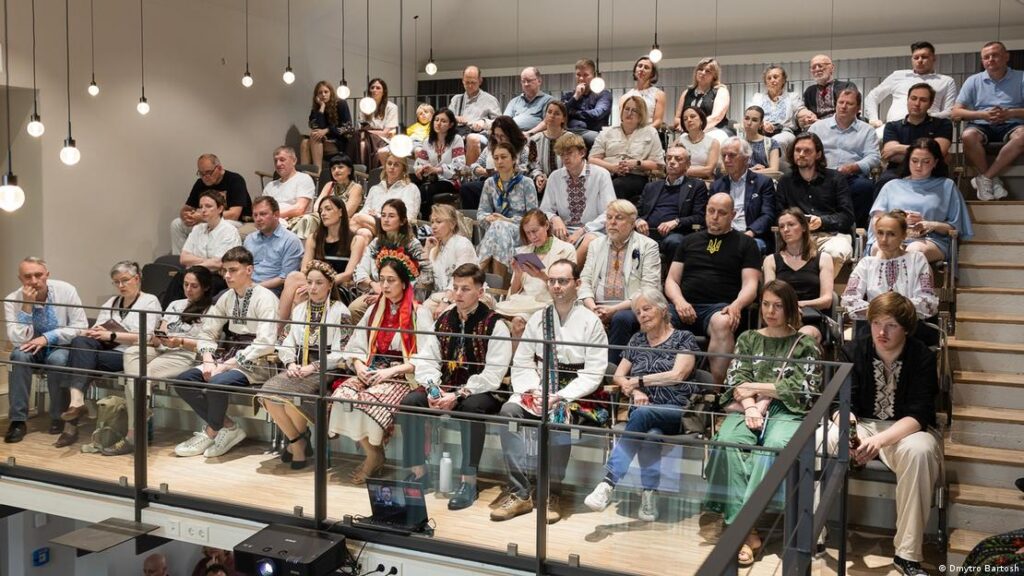
On May 30, 2026, in Bad Ems, a small town in Rhineland-Palatinate in southwestern Germany, the 150th anniversary of the notorious Ems Decree was commemorated. Right next to the Vier-Türme building—the site where the russian tsar signed the Ems Decree 150 years ago—an event was organized to celebrate the Ukrainian language and honor its long struggle against oppression. Several Ukrainian initiatives, including the Ukrainischer Verein Mainz e. V., Rhein-Dnipro e. V., and the Ukrainian Students Association Cologne (USAC), had put together a diverse program, called “The future belongs to freedom—and it speaks Ukrainian.”
Prof. Dr. Olexiy Khabyuk from the University of Applied Sciences Düsseldorf, who moderated the afternoon, welcomed all attendees and opened the program with the first item on the agenda—classical Ukrainian music performed by Olga Glibovych on the violin and Yaromyr Bozhenko on the piano, who later, between speeches and at times accompanied by Emanuel Matz on the cello, delighted the audience with their musical performance.
Oliver Krügel, the mayor of Bad Ems, delivered the welcome remarks. He emphasized how important it was to him that this event was taking place in his city and reaffirmed his municipality’s support for Ukraine. Günther Jertz, Ukraine’s Honorary Consul für Rheinland-Pfalz in Mainz, and Taras Zholubak, Head of the General Consulate in Frankfurt am Main, extended their greetings to everyone present and emphasized the importance of the event.
In a video message, Rostyslav Ohryzko, Deputy State Secretary of the Cabinet of Ministers of Ukraine, spoke about the restrictions Ukrainians face in russian-occupied territories and the tragic relevance of the Ems Decree today.
Many other prominent Ukrainians, such as Nobel Peace Prize Winner Oleksandra Matviichuk and former Ukrainian Ambassador to Germany and current permanent pepresentative of Ukraine to the United Nations in New York Andriy Melnyk, also addressed the participants with messages of greeting, which attendees could view on the event website.
For the academic portion of the event, Prof. Dr. Michael Moser from the University of Vienna, one of the most renowned Slavic Studies experts in the field of the Ukrainian language, first gave a lecture about the Ukrainian language and its development in recent years. Above all, he refuted the russian regime’s allegations that the russian language is banned in Ukraine and instead documented the repression of the russian occupiers against the Ukrainian-speaking population.
Prof. Dr. Gerhardt Simon of the University of Cologne examined the historical development of the Ukrainian language, which prevailed despite all bans and ultimately became a driving force in the formation of the Ukrainian nation. He also explained how russia has been using the same narratives for centuries to deny Ukraine its own language and identity.
Following the historical input, war photographer Till Mayer presented his own photographs to illustrate the daily lives of civilians in Ukrainian cities and Ukrainian soldiers on the front lines. He highlighted the unique stories and people he consistently encounters during his work in Ukraine, as well as the desire for freedom and self-determination that he sees so strongly among the Ukrainian population.
The event concluded with remarks from the organizers Maryana Boyko-Kempski (Ukrainischer Verein Mainz e.V.), Borys Ivanchov (Rhein-Dnipro e.V.), and Ulyana Derkach (Ukrainian Students Association Cologne), who introduced the final item on the program—a presentation of original Ukrainian traditional costumes (vyshyvanka) dating back more than 100 years. The display of traditional clothing was once again accompanied by Ukrainian musical classics, thus reaffirming that the future belongs to freedom—and it speaks Ukrainian.
- DW Ukraine: “150 років Емському указу: як українська мова перемогла“, by Dmytro Kaniewski (Дмитро Каневський)/ Wie die ukrainische Sprache russische Verbote überlebte, von Dmytro Kaniewski
DUAG members Dr. Olesia Lazarenko (Europa-Universität Viadrina Frankfurt (Oder)) and Prof. Dr. Stephaniya Ptashnyk (Universität Heidelberg/ Heidelberge Akademie der Wissenschaften) contributed to this event.
About the author: Jasper Medenwald wrote his thesis on the narratives of russian propaganda and is currently learning Ukrainian.
Photo: Courtesy of Dmytro Bartosh.