Report was prepared by Pr. Dr. Iryna Shvetsova. Photos: private
On 26 June 2026, Martin Luther University Halle-Wittenberg hosted the Third Ukrainian Academic Day (3. Ukrainischer Akademischer Tag), an annual academic event that, for the third consecutive year, brought together about 50 Ukrainian and international researchers, academics, students, and members of the wider community committed to supporting Ukrainian scholarship and German-Ukrainian academic cooperation.
The event aims to support the Ukrainian academic community, increase the visibility of Ukrainian research, and foster international and interdisciplinary academic dialogue.
The event was co-organised by Dr. Helmut Podhaisky (Martin Luther University Halle-Wittenberg) and Prof. Dr. Iryna Shvetsova (Kherson State Maritime Academy). This year’s event continued an initiative launched in 2024 that has developed into an important platform for presenting Ukrainian research and strengthening international academic connections.
The event was held with the support of the Vice-Rectorate for Research, Internationalisation and Transfer at Martin Luther University Halle-Wittenberg and Ukraine-Hilfe Spergau e.V.
The academic programme covered a broad range of topics, from history and international law to Ukrainian cultural heritage and contemporary biotechnology, once again highlighting the interdisciplinary character of the Ukrainian Academic Day.
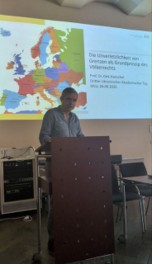
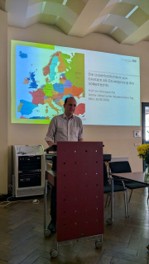
The first session was chaired by Dr. Boris Wille. Prof. Dr. Yvonne Kleinmann addressed the role of German-language Eastern European Studies in the context of Russia’s war against Ukraine. Prof. Dr. Dirk Hanschel discussed the inviolability of borders as a fundamental principle of international law and its significance for contemporary Europe.

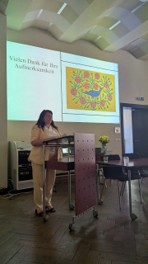
The second session was chaired by Prof. Dr. Iryna Shvetsova (Kherson State Maritime Academy; member of the German-Ukrainian Academic Society). The session opened with Dr. Eka Tchkoidze (Martin Luther University Halle-Wittenberg / Ilia State University, Georgia), who presented “Greek Minority in Ukraine.” Her presentation offered an in-depth historical exploration of the Greek community in Ukraine, its cultural heritage, and its role in shaping the multicultural landscape of the Northern Black Sea region. The next presentation, “The Folk Tale as a Mental Model of the Ukrainian Worldview” was delivered by Prof. Dr. Alona Leshchenko (Kherson State Maritime Academy). Her contribution explored the Ukrainian folk tale as an important element in shaping national identity, cultural memory, and the values underlying the Ukrainian worldview. The academic programme concluded with Dr. Anatoli Giritch (Nomad Bioscience, Halle; member of the German-Ukrainian Academic Society), who presented “Green Plants as Biofactories for Production of Recombinant Proteins for Medical and Food Applications.” His presentation introduced recent developments in plant biotechnology and explored the potential of plants as platforms for producing recombinant proteins for medical and food applications.
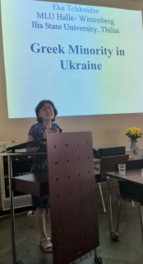
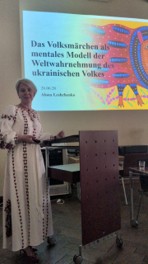
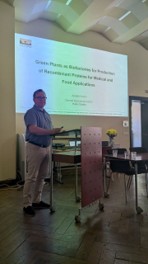
All presentations generated considerable interest and were followed by lively discussions. The exchange of questions and perspectives after each contribution reflected both the relevance of the topics addressed and the high academic quality of the research presented.
It was particularly encouraging to welcome not only new participants but also scholars who had contributed to previous Ukrainian Academic Days. Their continued engagement demonstrates how the Ukrainischer Akademischer Tag is developing into a sustainable platform for presenting Ukrainian research, building professional networks, and strengthening German-Ukrainian academic cooperation.
Following the academic programme, participants continued their conversations in an informal setting, exchanged ideas and experiences, discussed opportunities for future cooperation, and established new professional connections.
The Third Ukrainian Academic Day once again demonstrated that Ukrainian scholarship is an integral part of the European academic landscape and that international cooperation continues to create new opportunities for scholarly dialogue, professional connections, and collaborative research initiatives.